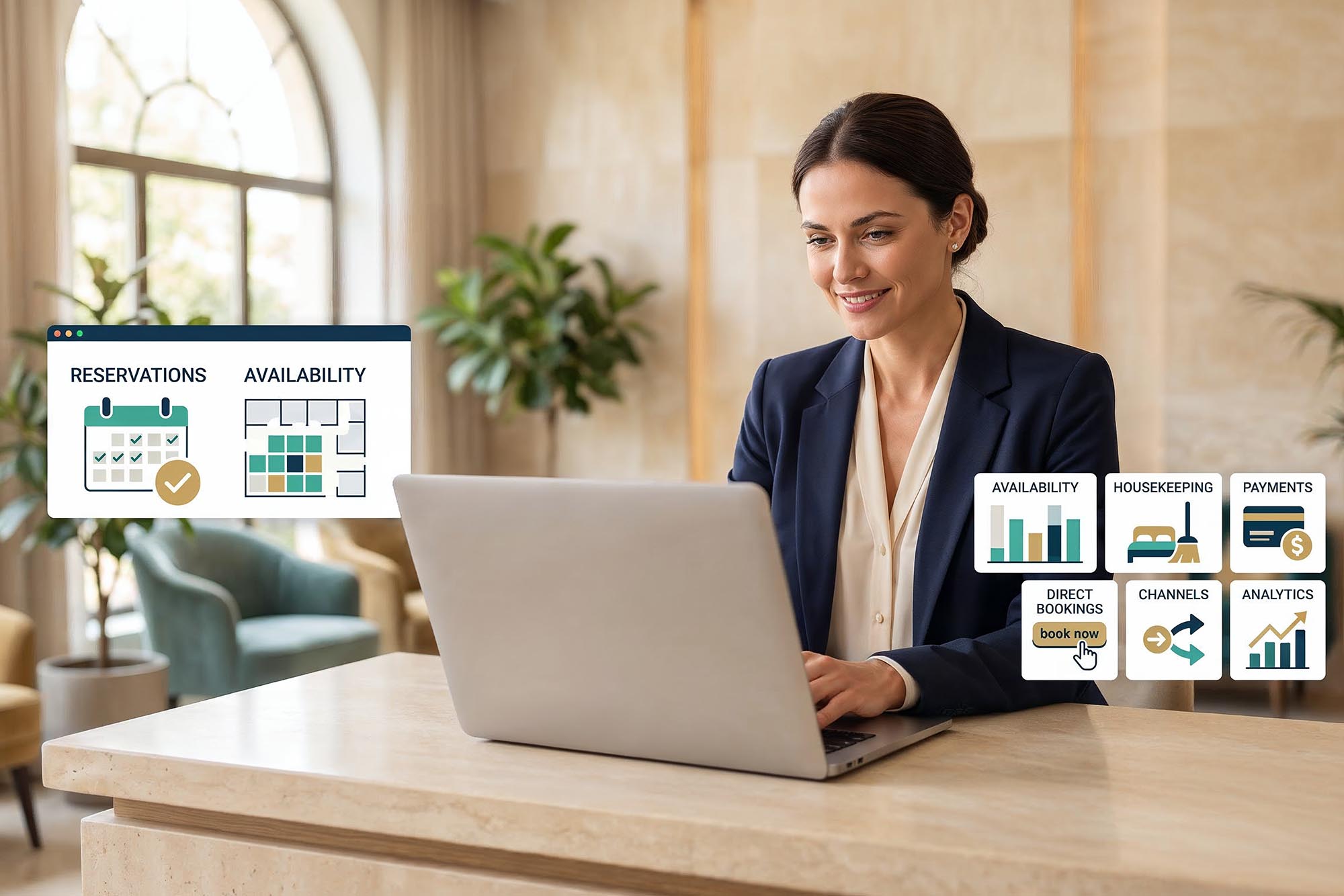
For independent hotel owners, finding the best PMS for independent hotels means looking beyond price and focusing on usability, features, integrations, and support.
Running an independent hotel in 2026 requires more than comfortable rooms and excellent service. Hotel owners and managers must also manage online bookings, room availability, housekeeping, guest communication, payments, reporting, and multiple sales channels—often with a small team.
That is why choosing the best PMS for independent hotels has become an important business decision. The right property management system can reduce manual work, prevent booking errors, improve staff coordination, increase direct bookings, and give hotel owners better control over daily operations.
However, the best hotel management system is not necessarily the one with the longest feature list. It is the one that matches your property size, operating style, budget, team, and growth plans.
What Is a Hotel PMS?
A hotel PMS, or property management system, is software that centralizes the core operations of a hotel. It typically helps teams manage:
- Reservations and room availability.
- Front desk operations.
- Check-ins and check-outs.
- Guest profiles and preferences.
- Housekeeping and room status.
- Billing and payments.
- OTA and channel management.
- Reports and business analytics.
- Guest communication and experience management.
Modern hotel management software combines several of these functions in one platform instead of requiring staff to switch between separate spreadsheets, booking calendars, messaging tools, and accounting systems.
For independent properties, this centralization is particularly valuable. A small hotel may not have separate teams for reservations, revenue management, housekeeping, and finance. A connected PMS helps the same team work from accurate, up-to-date information.
Why Independent Hotels Need the Right PMS
Independent hotels compete with large hotel chains, online travel agencies, vacation rentals, and other local properties. Technology can help them compete more efficiently without losing their personal approach to hospitality.
1. Reduce manual tasks
A PMS can automate or simplify repetitive work such as updating room availability, creating guest records, preparing invoices, assigning rooms, and generating reports.
2. Prevent overbookings
When reservations from different sources are managed separately, availability errors can occur. A PMS with channel management capabilities can help synchronize rates and inventory across connected booking channels.
3. Improve the guest experience
Faster check-ins, accurate booking details, personalized guest profiles, and timely communication can create a smoother experience from reservation to checkout.
4. Increase direct bookings
A booking engine connected to your website can allow guests to reserve rooms directly. This can help reduce dependence on third-party channels and support stronger relationships with guests.
5. Make better business decisions
Reports on occupancy, revenue, room performance, cancellations, and booking sources help hotel owners identify what is working and where improvements are needed.
Industry comparisons of hotel management software commonly recommend evaluating the complete operational workflow, including reservations, front desk, housekeeping, billing, channel management, integrations, and total cost of ownership—not just the monthly subscription price.guideflow+1
Essential Features of the Best PMS for Independent Hotels
Before comparing vendors, create a list of must-have features for your property. The following capabilities should be considered essential in 2026.
1. Reservation and Front Desk Management
The PMS should provide a clear view of room inventory, reservations, arrivals, departures, cancellations, walk-ins, and room assignments.
Look for features such as:
- Drag-and-drop reservation calendars.
- Individual and group booking management.
- Real-time room availability.
- Automated booking confirmations.
- Guest registration and profile management.
- Check-in and check-out workflows.
- Room upgrades and special requests.
- Waitlist and cancellation management.
The front desk interface should be simple enough for new staff to learn quickly. A system with advanced features is not useful if employees find it confusing during busy periods.
2. Channel Manager and OTA Integration
Many independent hotels receive bookings from online travel agencies such as Booking.com, Expedia, Agoda, Airbnb, and regional booking platforms. Managing availability manually on every channel can waste time and increase the risk of double bookings.
A channel manager should help synchronize:
- Room availability.
- Rates.
- Restrictions.
- Booking updates.
- Cancellations.
- Room types and inventory.
Before purchasing a PMS, confirm exactly which OTAs and distribution channels it supports. Also ask how frequently updates are synchronized and what happens if an integration temporarily fails.
3. Direct Booking Engine
A direct booking engine allows guests to book through your hotel website without calling the front desk or using an OTA.
Important booking engine features include:
- Mobile-friendly booking flow.
- Real-time room availability.
- Multiple room types and rate plans.
- Promo codes and packages.
- Secure payment support.
- Automated confirmations.
- Integration with your website.
- Guest data capture for future marketing.
Direct bookings can help your hotel build a first-party guest database and reduce reliance on commission-based channels.
4. Housekeeping and Room Status Tracking
Housekeeping teams need accurate information about room status. A good PMS should make it easy to see whether a room is:
- Vacant and clean.
- Vacant and dirty.
- Occupied.
- Out of order.
- Inspected.
- Ready for arrival.
The system should also allow managers to assign cleaning tasks, update room status from a phone or tablet, and notify the front desk when rooms are ready.
Patel HMS highlights reservation and front desk management, housekeeping, and room status tracking as part of its hotel management platform.linkedin+1
5. Billing, Payments, and Folio Management
Billing errors can affect both profitability and guest satisfaction. Your PMS should make it easy to post room charges, add services, process payments, manage deposits, and issue accurate invoices.
Check whether the system supports:
- Multiple payment methods.
- Split payments.
- Refunds and cancellations.
- Deposits and advance payments.
- Tax configuration.
- Guest folios.
- Company or group billing.
- Payment gateway integrations.
- Daily reconciliation reports.
Ask vendors about payment processing fees, transaction charges, hardware requirements, and whether payment information is securely handled.
6. Guest CRM and Communication
A modern PMS should help you maintain useful guest profiles while respecting privacy and data protection requirements.
Useful CRM capabilities may include:
- Guest contact information.
- Stay history.
- Preferences and special requests.
- Birthday or anniversary details.
- Corporate account information.
- Pre-arrival messages.
- Post-stay feedback requests.
- Email or SMS communication.
For independent hotels, guest data can support repeat bookings and more personalized service. The system should also provide role-based access so employees only view the information required for their work.
7. Reporting and Analytics
Reports help hotel owners move from guesswork to informed decisions. At a minimum, your PMS should provide reports on:
- Occupancy.
- Average daily rate.
- Revenue per available room.
- Revenue by room type.
- Booking source.
- Cancellation trends.
- No-shows.
- Payment settlements.
- Tax and financial summaries.
- Staff and operational activity.
The best hotel management system will allow managers to filter reports by date, room type, booking source, and property. Export options can also be important when your accountant or management team needs the data in another format.
8. Mobile and Cloud Access
Cloud-based PMS software allows authorized users to access hotel information without being tied to a single computer at the front desk.
Mobile access can be useful for:
- Checking occupancy while away from the property.
- Monitoring arrivals and departures.
- Updating room status.
- Reviewing reports.
- Managing reservations.
- Coordinating with housekeeping.
- Handling urgent guest requests.
Cloud systems may also reduce the need for hotels to maintain local servers, although you should still ask about backups, uptime, data ownership, and offline procedures.
How to Compare Hotel Management Systems
Once you have identified the required features, compare systems using your actual workflows rather than generic demonstrations.
Consider your property type and size.
A 20-room boutique hotel may need a fast and simple platform, while a 100-room property may require more advanced reporting, revenue tools, integrations, and user controls.
Think about:
- Number of rooms.
- Number of properties.
- Number of employees.
- Seasonal occupancy.
- Group bookings.
- Restaurant or spa operations.
- Multiple room types.
- Expansion plans.
The system should be powerful enough for your current needs but not unnecessarily complex.
Evaluate ease of use
Ask the vendor to demonstrate common tasks such as:
- Creating a reservation.
- Modifying a booking.
- Checking in a guest.
- Assigning a room.
- Processing a payment.
- Marking a room clean.
- Generating an end-of-day report.
If these workflows require too many steps, your team may avoid using the system correctly.
Check integrations
Your PMS should connect smoothly with the tools your hotel already uses or expects to use. Important integrations may include:
- OTAs and channel managers.
- Website booking engine.
- Payment gateways.
- Accounting software.
- Point-of-sale systems.
- Revenue management tools.
- Door-lock systems.
- Guest messaging platforms.
- Business intelligence tools.
Request a current integration list and ask whether integrations are included in the subscription or charged separately. Open APIs and documented integrations can also support future flexibility.guideflow+1
Calculate the total cost.
Do not compare PMS platforms based only on their advertised monthly fee. Calculate the full 12-month cost, including:
- Setup and implementation.
- Data migration.
- Staff training.
- Subscription fees.
- Additional users.
- Extra properties.
- Channel manager charges.
- Booking engine charges.
- Payment processing fees.
- Support or maintenance fees.
- Hardware requirements.
- Premium reports or add-on modules.
A lower-cost platform may become more expensive if essential features are sold as separate add-ons.
Review support and onboarding.
Implementation is one of the most important parts of changing hotel software. Ask:
- How long does setup take?
- Who migrates existing reservations and guest data?
- Is training included?
- Is support available by phone, email, or chat?
- What are the support hours?
- Is emergency support available?
- Are training videos and documentation provided?
- What happens after the system goes live?
A responsive support team can make a significant difference during the first few weeks.
Why Patel HMS May Be a Strong Option for Independent Hotels
Patel HMS is positioned as a cloud-based hotel management platform designed to consolidate key hotel operations into a single system. Its stated capabilities include reservation and front-desk management, housekeeping and room-status tracking, channel manager and OTA integration, rate and revenue management, guest CRM, and guest-experience tools. linkedin
The platform is also described as supporting reservations, front desk operations, housekeeping, billing, point-of-sale, guest management, and reporting from a central system. linkedin
For an independent hotel, this type of connected approach can help reduce the number of separate tools used by staff. Instead of maintaining different information across spreadsheets, messaging apps, OTA extranets, and disconnected software, hotel teams can work from a more unified operational view.
Before making a final decision, request a Patel HMS demonstration using your real workflows. Ask the team to show how the platform handles your room types, rate plans, booking sources, payment process, housekeeping process, reporting requirements, and future expansion plans.
Questions to Ask Before Choosing a PMS
Use these questions when speaking with a hotel PMS provider:
- Can the system manage my property size and room types?
- Does it support my preferred OTAs and booking channels?
- Does it include a direct booking engine?
- Can I manage reservations, billing, housekeeping, and reports in one place?
- Is the system cloud-based and accessible on mobile devices?
- What payment gateways and accounting tools does it support?
- Can I import existing reservations and guest records?
- How long will implementation take?
- What training is included?
- What is the complete 12-month cost?
- Are support and software updates included?
- Can the system support additional rooms or properties later?
- How is guest and payment data protected?
- What happens if the internet connection is interrupted?
- Can I export my hotel data if I change providers?
A Practical PMS Selection Checklist
Follow this process to make your decision:
Step 1: List your operational problems
Identify the areas causing the most difficulty, such as overbookings, slow check-ins, disconnected reports, housekeeping delays, or low direct bookings.
Step 2: Define your must-have features
Separate essential features from optional features. This prevents an attractive sales presentation from distracting you from your real business needs.
Step 3: Shortlist three systems
Choose platforms that match your property size, location, budget, hotel type, and distribution strategy.
Step 4: Run a live demonstration
Ask vendors to demonstrate your actual booking-to-checkout workflow rather than showing only general features.
Step 5: Confirm integrations and costs
Request written confirmation of supported integrations, implementation charges, payment fees, and add-on pricing.
Step 6: Involve your staff
Front desk, housekeeping, finance, and management teams may use the system differently. Their feedback can reveal usability problems early.
Step 7: Plan onboarding carefully
Set up user permissions, migrate data, train employees, and establish a go-live support plan before switching systems.
Final Thoughts
The best PMS for independent hotels in 2026 is the one that simplifies daily work while helping the property increase bookings, improve service, control revenue, and prepare for growth.
Look for a hotel management system that combines practical front desk tools with reservations, housekeeping, billing, channel management, guest CRM, reporting, and reliable support. Patel HMS can be considered by independent hotels looking for a connected platform to manage key hotel operations from one place.
The right choice should not be based on features alone. Evaluate the complete experience: usability, integrations, implementation, security, support, scalability, and total cost of ownership.
Ready to modernize your hotel operations? Visit Patel HMS to learn more and request a personalized demonstration.
Frequently Asked Questions
What is the best PMS for an independent hotel?
The best PMS depends on your property size, operational requirements, budget, integrations, and growth plans. Independent hotels should prioritize ease of use, reservations, front desk management, housekeeping, billing, channel management, reporting, and responsive support.
How much does hotel PMS software cost?
Pricing varies by provider, property size, number of users, features, integrations, and payment arrangements. Always compare the complete 12-month cost, including setup, training, add-ons, payment fees, and channel management charges.
Should an independent hotel use a cloud-based PMS?
Cloud-based PMS software can provide remote access, automatic updates, centralized data, and reduced reliance on local servers. Before selecting one, ask about data security, backups, uptime, mobile access, and procedures for internet interruptions.
Does a PMS help increase direct bookings?
A PMS with an integrated website booking engine can help hotels accept direct reservations and keep availability updated. It may also support direct guest relationships and reduce dependence on third-party booking channels.
What should I ask during a PMS demo?
Ask the vendor to demonstrate a complete workflow, from receiving a reservation to assigning a room, checking in the guest, posting charges, updating housekeeping status, processing checkout, and generating reports. Also request clear information about integrations, implementation, support, and total pricing.